Tell a story
An approved video, photograph or sponsored article can introduce a business through an athlete’s own perspective and genuine experience.
Define the story, filming time, approvals and where it will run.

CVA Athlete Partnerships · Name, Image & Likeness
A great local campaign starts with a real connection. Explore how athletes and Coastal Virginia businesses can bring their stories, creativity and community ties together.
CVA is developing a hub for athlete partnerships. Start with the ideas and practical guidance below, then tell us about your interest.
The opportunity
NIL stands for name, image and likeness. A business pays an athlete for defined promotional work, such as appearing in an advertisement, creating approved social content or attending a business event. The agreement sets out the work, payment, timing and permitted use of the athlete’s identity.
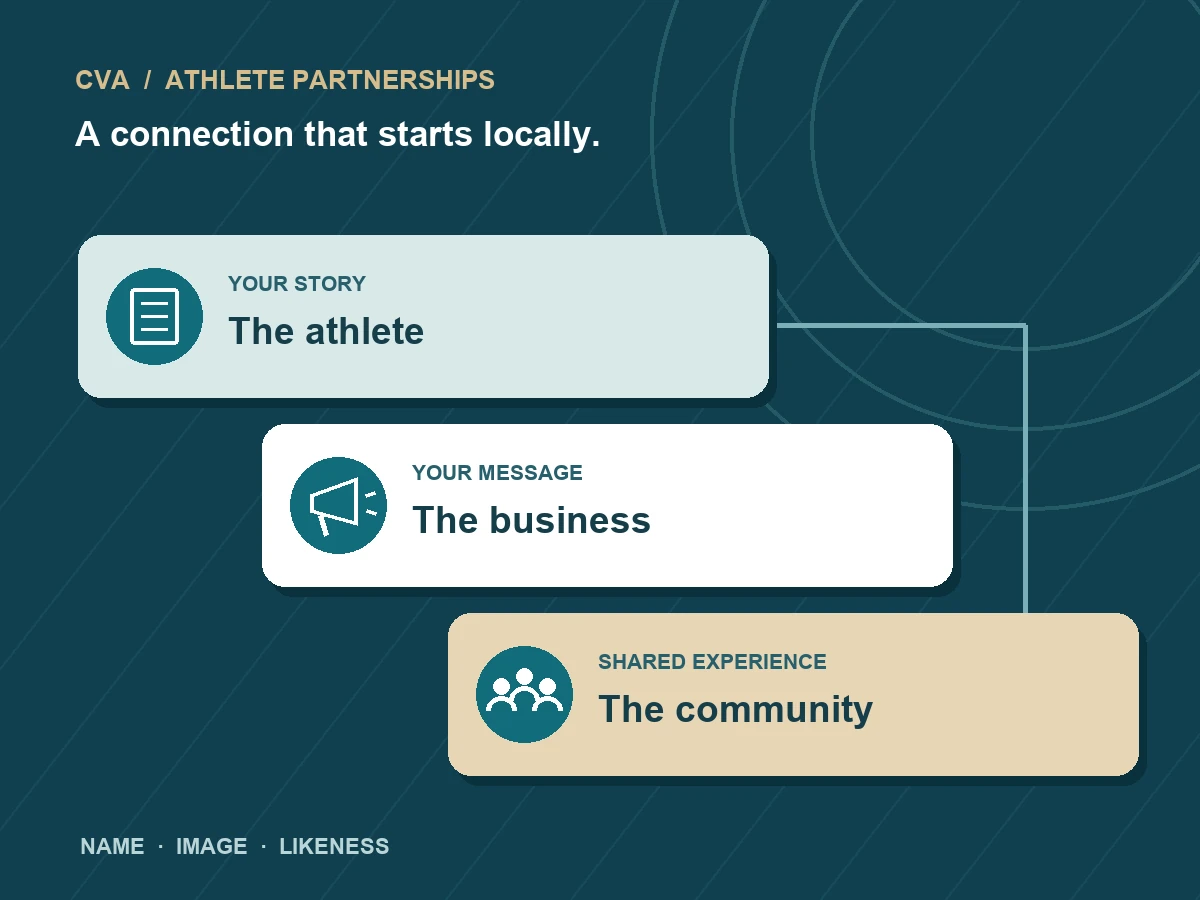
The strongest starting point is a good fit: an athlete who connects with the idea, a business with a clear message and an experience its customers will value.
Start with a useful idea
These are examples to explore, subject to the athlete’s rules and permissions.
An approved video, photograph or sponsored article can introduce a business through an athlete’s own perspective and genuine experience.
Define the story, filming time, approvals and where it will run.
A scheduled appearance or meet-and-greet can add a personal connection to a business opening, community gathering or customer event.
Agree on the activity, location, duration and permitted promotion.
A defined social campaign can introduce a product or service through approved posts, with clear sponsorship labels and agreed usage.
Specify the channels, number of posts, dates and reporting.
For local businesses
Think about the people you want to reach and the action you want them to take. A clear campaign brief makes the next conversation more useful.
Athlete compensation and any representation fees should be identified separately from CVA advertising and production charges.
Discuss CVA media for a campaign →
Use “NIL business interest” in your message.
For athletes & parents
Consider the kinds of businesses, products and activities that fit you. You decide whether a potential opportunity is right for you.
Keep a minor’s home address, daily schedule and private contact details out of a public profile. A parent or guardian should make the initial inquiry for a minor.
Share athlete or parent interest →
Use “NIL athlete interest” in your message. Do not send identity documents or financial information.
A clear campaign from the start
Write down the actual promotional deliverables, deadlines and approval steps.
Confirm the athlete, business, guardian where needed and any properly registered representative.
Resolve school disclosure, photo and video rights, branding, permitted channels and the usage period.
Specify compensation, payment timing, cancellation and how completion will be documented.
Practical requirements
Reviewed November 4, 2026 · Virginia-focused guidance
The school, athletic association and level of competition matter. Use the official sources below and confirm the current process with the athlete’s school before signing.
Virginia law permits high-school NIL earnings and requires athletes to disclose a proposed agreement to their school before signing. Schools can restrict conflicts with existing agreements and activity during school or team obligations. Certain sponsor categories—including alcohol, tobacco, gambling and weapons—are prohibited; the statute contains the full list. Virginia high-school NIL law ↗
VHSL: The 2026–27 handbook prohibits school references, uniforms and school marks in NIL activity, restricts school-affiliated deal facilitators and requires written notice to the principal or athletic director within 72 hours after entering a contract. That notice does not replace the state’s pre-signing disclosure. Current VHSL handbook, rule 28B-2 ↗
VISAA’s 2026–27 manual allows NIL while prohibiting compensation tied to enrollment, athletic participation or achievement, or work not performed. Its rules also prohibit school/VISAA references, uniforms and marks in NIL activity, and compensation from a school NIL collective. School and conference requirements still need checking. VISAA policy manual, section 7.11 ↗
Virginia college athletes must disclose proposed agreements to their institution before signing and follow its NIL policy. Virginia college NIL law ↗
NCAA Division I athletes must report third-party NIL deals valued at $600 or more in aggregate, including royalties, bonuses and contingent compensation, through NIL Go. The College Sports Commission sets a deadline of five business days after entering the agreement or agreeing to payment terms. Review includes the business purpose and compensation. High-school prospects entering Division I have a separate timeline: qualifying deals must be reported within 14 days after starting full-time classes or before the first Division I competition, whichever comes first. Keep records while in high school and check which deals count. These Division I requirements should not be applied automatically to other college associations. College Sports Commission reporting guidance ↗ · NCAA athlete and prospect guidance ↗
Virginia requires written consent to use a person’s name or likeness in advertising or trade; a parent or guardian provides that consent for a minor. Photographer licensing is a separate permission. A photograph used in a sports story is not automatically approved for an advertisement. Virginia commercial-consent law ↗
Make a paid or gifted brand relationship clear with the endorsement itself. Money, free products and discounted services can all create a connection that needs disclosure. FTC disclosure guidance ↗
Virginia requires athlete-agent registration for covered representation. Its definition includes arranging, negotiating and managing NIL opportunities; calling the fee an advertising or production charge does not itself settle the question. Confirm the representative’s registration and the scope of the services before authorizing someone to act for an athlete. Virginia agent definition ↗ · Registration requirement ↗
Tell CVA what you have in mind. We’re gathering business and athlete interest as this section develops.
This page provides information and a general inquiry route. Athlete representation, deal negotiation and payments are not offered through this page.